Context
Most Texans never write a will. Lawyers are expensive, the process is intimidating, and generic online templates don't know when your situation is too complex for a template.
The problem
Estate planning is a high-stakes legal domain: a wrong answer can't be "probably right". A responsible product has to do two things at once. It must make the simple case genuinely simple, and reliably recognize the complex case it should not handle.
What I owned
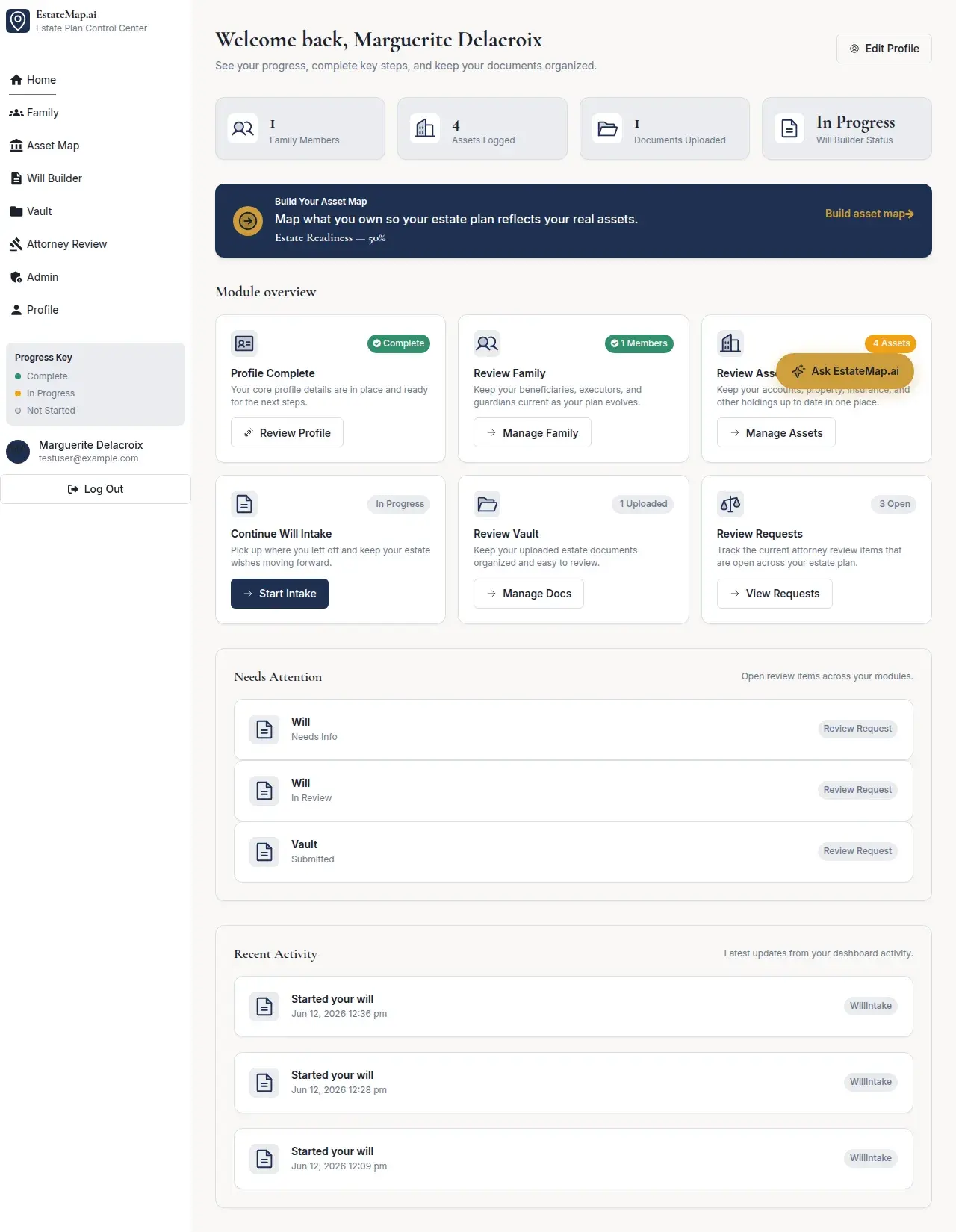
The product logic end to end: a guided 25-step will intake, the decision rules that classify each case, attorney escalation, document vault, asset mapping, and the AI assistant that supports users along the way.
How it works
Key decisions
- Rules decide; AI assists. The legal path is a deterministic decision tree with hard stops. Disinheriting a spouse or child, special-needs beneficiaries, trust planning, blended families, business succession, or non-Texas residency each block self-service and escalate to an attorney. None of that is left to a model's judgment.
- The will is never generated from chat. Documents are assembled only from the structured intake. The AI assistant is closed-domain: it answers questions about the process from a curated knowledge base, with a fallback when it doesn't know. It cannot draft legal content.
- Escalation is a feature, not a failure. Attorney review is a first-class flow with its own review queue, not an error state.
Verification
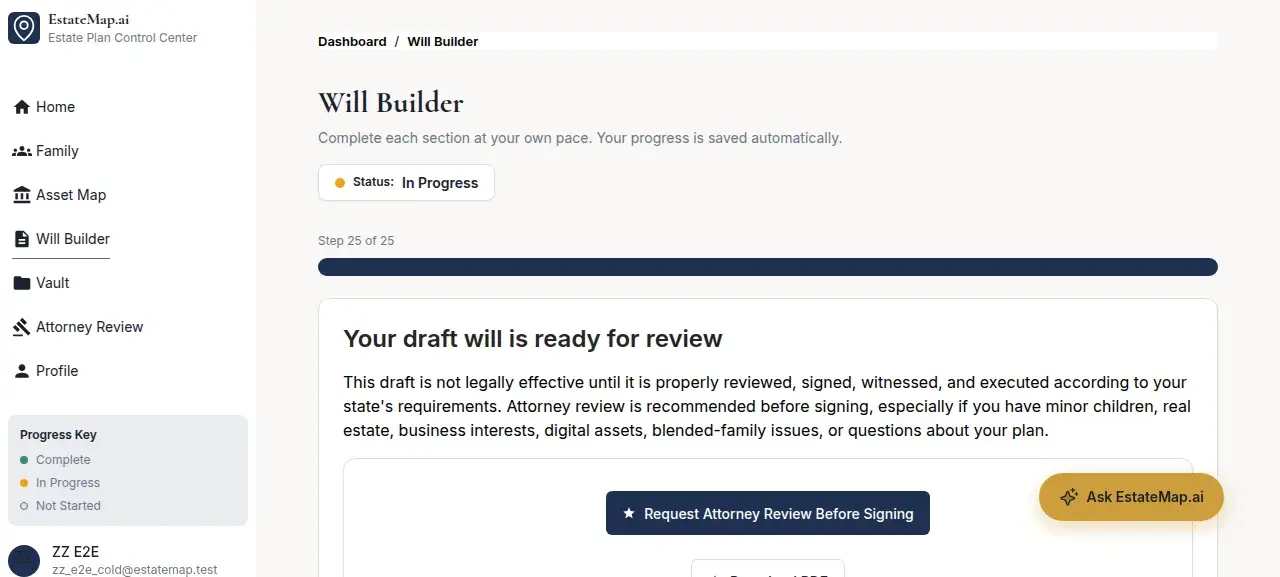
Every feature ships with scripted end-to-end verification against the test environment, dozens of automated checker scripts and screenshot-based reviews accumulated over the project.
Outcome
In advanced development on a client-facing test environment, in active iteration with the client. The core flows are built and working, from intake and document assembly to escalation, vault, and the assistant.
What I'd improve today
The intake is thorough but long; I'd invest in adaptive branching to shorten the path for the simplest estates.